
 Shears, demolition jaws for excavators
 Hydraulic drill rigs
 Hydraulic pile drivers for excavators
 Screening buckets for excavators
 Hydraulic grapples for excavators
 Chain trenchers
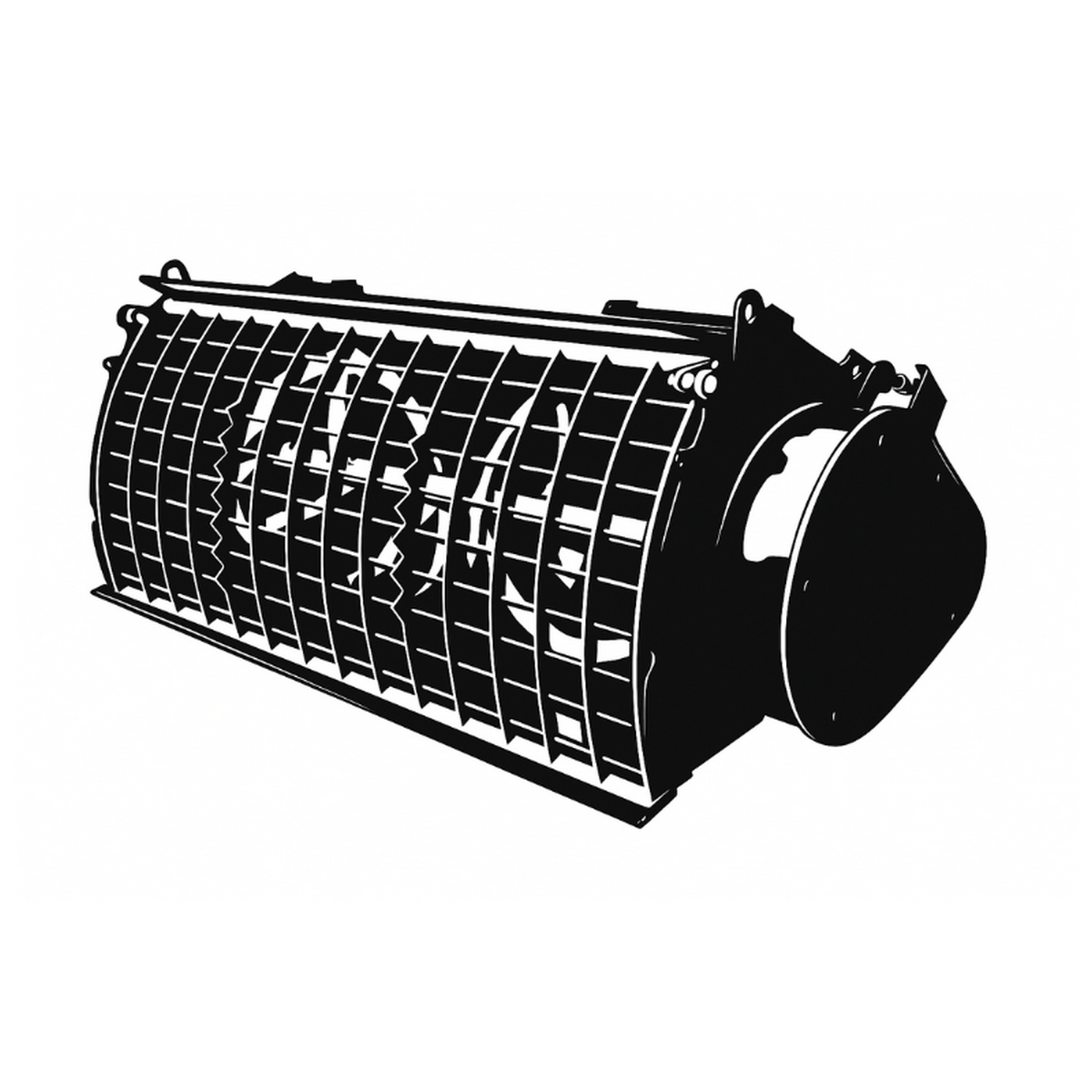 Mixing buckets for excavators
 Flail mowers
Hydraulic hammers are some of the most important tools used on today's construction and demolition sites. Thanks to their tremendous percussive power and their ability to be mounted on a variety of machines - from mini-excavators to backhoe loaders - they significantly speed up the crushing of concrete, rock, slag or road surfaces. This list presents the Top 10 practical applications for hydraulic breakers, showing how versatile and indispensable they are in the construction, industrial and mining sectors.
Hydraulic breakers hammers for excavators - how do they work and what are they used for?
Hydraulic hammers are some of the most effective tools for crushing, breaking and demolishing hard structures, used in both construction and industrial work. Their operation is based on the energy generated by the machine's hydraulic system, which converts oil pressure into a powerful impact force. This allows the hammer to crush concrete, rock or asphalt accurately and quickly, while minimising operator effort. That's why hydraulic breakers for mini excavators are so highly valued for off-road work, where manoeuvrability and the ability to reach hard-to-reach areas are important.
For larger projects requiring the demolition of massive structures, demolition breakers for excavators with demolition breaker for backhoe loaders are used, which have even more power and reach. These solutions allow demolition work to be carried out quickly without the need for heavier, more costly machines. Both light and heavy hydraulic breakers combine performance, durability and a wide range of applications, making them an integral part of modern construction sites and processing plants.
Hydraulic hammers in action - demonstrating applications in the construction and industrial sectors
Hydraulic hammers are some of the most versatile tools used in construction, mining, demolition and heavy industry. Thanks to their tremendous percussive power and ability to work in a wide variety of conditions, they perform well wherever efficient crushing, breaking or removal of hard materials is required. Below are 10 common applications for hydraulic hammers that best demonstrate their potential and key role in modern projects.
1. building demolition
Hydraulic hammers are an essential tool in the demolition of massive structures, especially where speed and the ability to precisely control the direction of destruction are important. Thanks to the enormous impact force, the equipment effectively crushes concrete walls, ceilings and reinforced concrete partitions.
In the case of total building demolition, the hammer significantly reduces work time while reducing the need for explosive charges. Operators value it for its safety, stability and ability to work even in difficult urban conditions.
2 Road surface removal
Roadworks require tools that can quickly tackle hard surfaces such as concrete or asphalt. Hydraulic hammers effortlessly break up even thick layers of pavement, enabling work fronts to be opened efficiently.
This equipment is indispensable both on motorways and in city centres, where work speed and precision are crucial. Thanks to its high efficiency , masses of pavement can be removed in a short space of time, minimising road disruption.
3 Foundation demolition
Deep foundations and piled elements present a major challenge for earthworks. Hydraulic hammers make it possible to quickly crush hard, monolithic structures without the need for explosive methods or time-consuming drilling.
Their high percussion force allows them to reach deeply recessed structural elements, greatly speeding up excavation and site preparation for new developments. It is both an economical and highly effective solution.
4 Secondary rock crushing
In quarries, hydraulic breakers are often used for secondary rock crushing, i.e. crushing larger boulders formed after primary processing. This makes it possible to obtain material of an appropriate fraction before subsequent processing steps.
The use of a hammer eliminates the need for heavy crushers in hard-to-reach areas. This is a significant time and energy saver, especially where rapid response to changing spoil patterns is important.
5. forging frozen ground
In foundation work carried out in winter, it is essential to break through frozen ground layers. Hydraulic hammers are excellent at dealing with hard, frostbitten ground, enabling excavation without delay.
Their use is particularly important in regions with harsh climates, where a thick layer of frozen soil can make classic digging methods impossible. The hammer makes it possible to maintain continuity of work, regardless of temperatures.
6 Tunnelling
In the confined space of tunnels, mining operations require a high degree of precision and safety. Hydraulic breakers allow controlled crushing of rock without the risk of uncontrolled debris or structural damage.
Their compact design and high efficiency make them ideal for both transport and mining tunnels. They can be used for widening, forging niches or preparing for technical installations.
7 Primary rock breaking
In quarries, hydraulic hammers are increasingly used as an alternative to blasting methods. They allow safe and precise rock breaking in areas that require special control.
The absence of shock and the reduction in noise is a huge advantage, especially where quarrying takes place close to buildings or infrastructure. It is also a greener and more predictable method.
8 Slag breaking in the steel industry
In the metallurgical industry, hydraulic hammers are used to break up hard, clumped slag layers. This process is essential to maintain the permeability of the equipment and the optimal operation of the plant.
Thanks to their resistance to high temperatures and ability to operate in harsh environments, hammers are ideal for use in steelworks halls. They allow efficient removal of production waste and prepare it for transport or further processing.
9 Crushing of steel scrap
In the metal recycling sector, hydraulic hammers are used to crush large steel components and structures that do not fit into standard cutting equipment. Their power allows the volume of material to be reduced quickly.
The scrap prepared in this way is easier to transport and process, which significantly affects the efficiency of the entire recycling process. This is one of the most cost-effective solutions for metal processing facilities.
Underwater work
Hydraulic hammers can also operate underwater, which opens up a wide range of possibilities in hydraulic engineering projects. In harbours, canals or during bridge construction, these tools make it possible to crush structures and rock below the water surface.
Their resistance to pressure and special seals make hammers suitable where other equipment is not. They are indispensable for underwater repairs, bottom regulation and foundation preparation.
How do you use hammers for excavators with demolition breakers?
In demolition work, it is crucial to select a hammer that suits the parameters of the machine and the nature of the work. The most important thing is to match the weight of the hammer with the tonnage of the excavator - too light will be inefficient and too heavy may damage the arm. Techna Poland offers: demolition breakers for excavators with demolition breaker for 3.5-10 t and hydraulic breakers for excavators with demolition breaker for crawler excavators with demolition breaker for 10-25 t so you can match the tool to your equipment. It is also worth paying attention to the percussion energy, operating frequency and type of hammerhead, in order to obtain maximum efficiency when breaking concrete or reinforced concrete.
Hydraulic breakers are indispensable tools in construction, demolition, mining and many specialised trades, and their correct selection and use will determine the effectiveness and speed of the job. From precision applications on mini excavators to powerful demolition breakers mounted on backhoe loaders, the right attachments significantly improve the performance of crews and increase work safety. That's why at Techna Poland, we offer high-end attachments for excavators that meet the requirements of even the most intensive projects and guarantee reliability in all conditions.
FAQ
- How do I choose a hydraulic breaker for excavators?
The most important thing is to match the weight of the hammer to the tonnage of the machine. Equipment that is too heavy can damage the arm and equipment that is too light will be inefficient.
- Are hydraulic breakers suitable for mini excavators?
Yes, there are special models with a lighter weight and compact design. They are ideal for work in confined spaces.
- What materials can be crushed with a hydraulic breaker?
Hammers are effective at breaking concrete, asphalt, rock, slag and steel structures. Their use depends mainly on the type of hammerhead and the impact energy. - How do I look after a hydraulic breaker while it is working?
Regular lubrication and inspection of the hydraulic system is key. This ensures that the equipment runs more efficiently and stays in working order for longer.
- Can hydraulic hammers operate under water?
Yes, selected models are suitable for underwater operation. However, they require seals and proper maintenance.
- What affects the service life of a hydraulic breaker?
Correct working technique and regular maintenance are key. Avoiding working 'in the air' significantly reduces wear and tear on components.
- Can a hydraulic breaker replace explosives in a quarry?
In many cases yes, especially where greater supervision and safety is required. It is a more predictable and environmentally friendly method of crushing rock.
- What are the most common uses of demolition breakers for excavators with demolition breaker for backhoe loaders?
They are used for building demolition, foundation crushing and pavement removal. They stand out for their high power and versatility.
- Which chisel for hydraulic breakers should I choose?
A spike is suitable for spot crushing, a wedge for delaminating and a chisel for cutting parts. The choice depends on the type of work to be carried out.
- Does a hydraulic demolition breaker increase the speed of demolition work?
Yes, it significantly speeds up the crushing of hard materials and the opening of work fronts. A well-chosen model can reduce completion times by up to several tens of per cent.
Read also:
- The wrong hammer is a big problem. How do you choose the right model for your excavator?
- How does a hydraulic breaker work?
- Hydraulic breakers for excavators with demolition breaker - what to look for when choosing one?
- Excavator demolition breaker operation - how to extend its life?
- When to buy a demolition hammer and when to rent one?
- New tempts with warranty, used with price - how to make a good decision when buying a hydraulic breaker?
- The most common faults and failures of hydraulic hammers - how to solve them?
- Hydraulic breaker versus pneumatic breakers for excavators - differences, disadvantages, applications
- Hammer or hydraulic hammer breaker - which will work better on your excavator?
- Don't choose blindly - find out the real differences between hammer and vibratory hammer
- Hydraulic hammer lubrication - which hammer lubricant to choose?
- How to choose a hydraulic breaker for mini excavator?
- How to connect a hammer for excavator with demolition breaker?
- Working pressure and oil flow in hydraulic hammers
 Previous
